

Brief news - Seen on
2013 completions of large solar thermal power plants mark technology gains
19 November 2013
Several large, new solar thermal power plants are expected to begin commercial operation by the end of 2013, more than doubling the solar thermal generating capacity in the United States. The projects use different solar thermal technologies and storage options. Abengoa's Solana plant, which came on line in October 2013, is a 250-megawatt (MW) parabolic trough plant in Gila Bend, Arizona with integrated thermal storage. BrightSource's Ivanpah, expected to enter service by the end of 2013, is a 391-MW power tower plant in California's Mojave Desert and does not include storage.
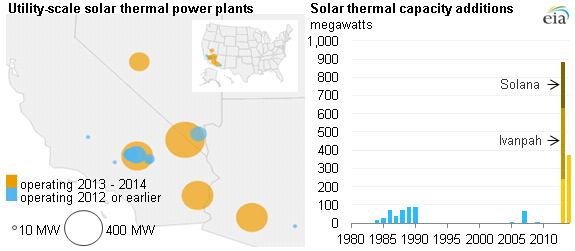
Solana and Ivanpah are much larger than solar thermal plants that have previously entered service in the United States. Over the past decade, a few smaller-scale and demonstration solar thermal projects have entered service. The only other dedicated solar thermal plants larger than 10 MW in the United States are the series of Solar Energy Generating System (SEGS) plants built in California in the 1980s and early 1990s and the Nevada Solar One parabolic trough project completed in 2007.
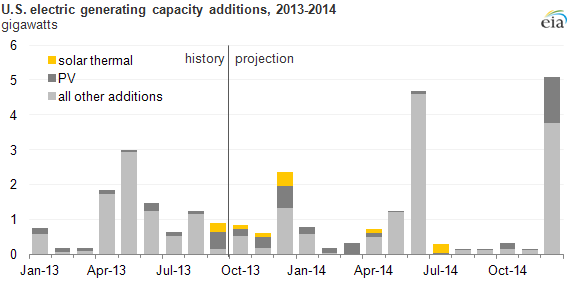
EIA projections for total solar thermal capacity additions in 2013 and 2014 include six projects for a total of 1,257 MW, with more expected in 2015 and 2016. However, while these solar thermal capacity additions are significant for the technology, they represent only 4% of total expected capacity additions for 2013 and 2014 (see chart below). Solar thermal capacity additions also continue to be outpaced by solar photovoltaic (PV) capacity additions, even though solar PV has only meaningfully entered the utility-scale market in the past few years.
All five of the major solar thermal projects—including Solana and Ivanpah—that are scheduled to come on line in 2013 and 2014 were awarded loans through the U.S. Department of Energy's Loan Guarantee Program. Solana received a federal loan guarantee for $1.45 billion of the approximately $2 billion cost of the project, according to the parent company, Abengoa. BrightSource Energy reports a $1.6 billion federal loan guarantee on the approximately $2.2 billion Ivanpah project.
Principal contributors: Marie Rinkoski Spangler, Gwen Bredehoeft - US Energy Information Administration (EIA)
Brief News - Seen On
The CSP Today Guide: Chile can be downloaded free of charge from the website and it contains key information for solar developers about the Chilean Market
There has been much talk and interest over the past months about the Chilean CSP market. CSP Today is currently organizing for the first time an event in Latin America that will take place in July in Antofagasta, Chile. As part of the research efforts, CSP Today has compiled a free-to-download guide with the must-have information on how to...
As the concentrated solar power industry turns its attention to the Middle East and North Africa, CSP Today is hosting a webinar to discuss the opportunities on 12 February 2013.
Expectations are high that the Middle East & North Africa will be a key future market for CSP technology. The contrast between traditional markets around the world hitting roadblocks and recent publicised progress of plants such as Shams One (UAE) and Ouarzazate (Morocco) was highlighted in CSP Today’s recent guide...
Theodor Scheidegger, chief executive officer of Siemens AG’s solar business, has quit before a planned sale of the solar energy unit.
Siemens, Europe’s largest engineering company, replaced Scheidegger with Michael Axmann, chief financial officer of the unit on Feb. 1, said Guenter Gaugler a spokesman for Munich- based Siemens. Axmann is now CEO and CFO.
The solar energy unit was put up for sale in October, two years after its founding through acquisitions including Archimede Solar Energy and...
Seen on: CSP Today
Researchers at CSP Today have completed work on the brand new guide focused on the CSP market in the United States.
Hours of research has resulted in the general release of this resource, which provides exclusive analysis and data on the Ivanpah, Solana, Mojave, Crescent Dunes and Genesis CSP plants.
The guide examines the long-term impact these breakthrough projects will have on financing, regulation and the future project pipeline in the United States. Furthermore, it...
Seen on: myFOXPHOENIX.com
A key determinant for Concentrated Solar Power (CSP) or solar thermal power market trends is government policy support, as the market is relatively young compared to other renewable sources. The total cost of power generation from CSP technology is expensive compared to solar photovoltaic (PV) and wind technology. Solar PV module prices fell drastically in 2011 due to the significant PV module production capacity and inventory build-up. However, CSP has a large potential for future market...
Seen on: Arabian Business
Two Saudi government-owned funds have purchased a 19.4 percent stake in Saudi water and power project developer ACWA Power International, the company said on Saturday.
ACWA Power, formed in 2004 to bid for Saudi power projects, has contracted gross production capacity of 13,000 megawatts (MW) of power and 2.37m cubic metres a day of desalinated water, with an investment value in excess of US$17bn.
Seen on: CSP Today
Claims being made by Argentinean solar developer Solar Noa have attracted criticism from CSP experts, prompting concerns over the credibility of a planned 20MW project
Is the news about Argentina’s first CSP plant all it appears? This is the feeling that has been growing in certain solar industry circles since the recent announcement of a 20MW parabolic trough plant in Salta, northwest Argentina.
As part of the launch of this year’s MENASOL confer- ence, CSPToday has compiled a guide to the hottest markets open to CSP companies in the region – so that you can inform your business strategy and take advantage of the lucrative MENA opportunities.
To download the guide: visit this link
On November 24, 2012 the National Solar Thermal Test Facility (NSTTF) began testing of the Pratt Whitney Rocketdyne (PWR) solar receiver shroud. Fifteen days of solar testing are scheduled for this testing. The flux levels on the shroud range between 100 and 500 suns. The work is sponsored by PWR in cooperation with the Department of Energy (DOE).
Pages