

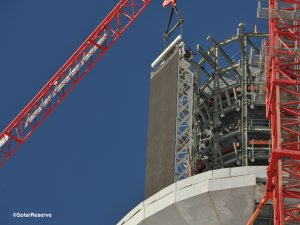
SolarReserve has achieved a new milestone in its Crescent Dunes CSP plant at Nevada. The molten salt receiver has been completely assembled atop the 540 ft tower
Crescent Dunes is a 110 MW tower plant under construction near the town of Tonopah that will be the first US commercial plant to use molten salt as Heat Transfer Fluid (HTF). Thanks to a couple of storage tanks, the molten salt --potassium and sodium nitrate-- heated at the receiver can be stored to be used when there's no sunlight. The plant is designed to operate for up to 10 hours with the stored heat.
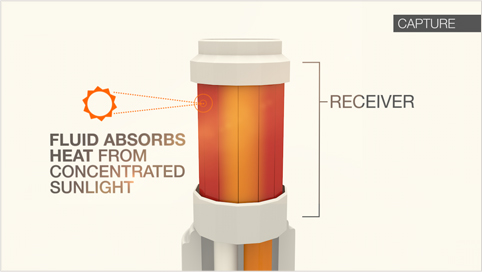
The receiver, developed by technology company Pratt Whitney & Rocketdyne, is actually comprised of panels made of hundreds of specially alloy tubes. The molten salt flows inside the tubes to collect the heat produced thanks to the concentration of sunlight reflected by thousands of mirrors called 'heliostats' placed around the tower that track the sun during the daylight.
"With more than 450 construction workers currently on site, the project is on course to bring American innovation to fruition," said Kevin Smith, CEO of SolarReserve. "The energy storage capability of this technology solves the problem of intermittency typical of other renewable energy sources. Additionally, because of its high efficiency, this technology can generate almost twice as much energy as a comparably sized solar facility, including facilities powered by photovoltaic panels or by a direct steam tower".
Once complete, the daylight production and the additional 10 hours of stored energy will generate roughly 500 GWh annually, enough to power 75,000 homes at peak electric demand periods, even after dark.
The $737 million project closed financing and initiated construction in September of 2011 and is scheduled to complete construction and start plant commissioning at the end of 2013, including first electricity production by the end of the year. The Crescent Dunes project has secured a 25-year power purchase agreement with NV Energy to sell 100 percent of the electricity output of the facility to serve homes across Nevada. The flagship project is jointly owned by SolarReserve, ACS Cobra Group, a worldwide leader in the engineering and construction of power plants and thermal solar facilities, and Santander Group, a global financial services and banking leader. ACS Cobra's Nevada-based affiliate, Cobra Thermosolar Plants Inc., is the general contractor for the project and is utilizing Nevada and regional subcontractors to perform the work.
According to SolarReserve, construction is expected to peak at more than 600 jobs on site during the 30-month construction period and is estimated to create more than 4,300 direct, indirect and induced jobs at companies throughout the U.S. that provide engineering, equipment supply and manufacturing, transportation and other value-added services.
The company highlights the local content for this project and said that, to date, orders for the project have been placed for equipment and services in more than 21 states. Once operational, the project will expend more than $10 million per year in salaries and operating costs, and is forecasted to generate $73 million in total tax revenues through the first 20 years of operation - contributing to workers' paychecks, service businesses, local school systems and police and fire departments.
The use of molten salt as HTF for tower plants has been proved since the early 80s in the US, Spain and France, but the first commercial project was commissioned in 2011 in Spain, Gemasolar, a 20 MW CSP plant with 15 hours of thermal storage. Crescent Dunes represents a major milestone in the use of this technology as it's the first large-scale project.
 Printer-friendly version
Related news