

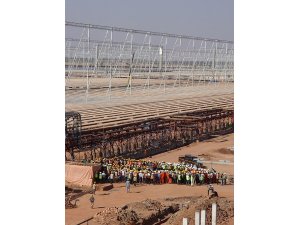
This month, March 2014, is the deadline for the extended period to start commercial operation of all the Concentrated Solar Power plants awarded under the National Solar Mission (JNNSM) program in 2010. So far, only one plant has come online, the Godawari Green Energy project and another one is being commissioned, the Rajasthan Sun Technique plant.
Only two out of the seven projects awarded will meet this extended deadline, the Godawari plant, a 50 MW parabolic trough facility, was commissioned last June and has begun commercial operation while the 100 MW linear Fresnel plant developed by Rajasthan Sun Technique, a subsidiary of Reliance Power, is about to send power to the grid. The Megha Engineering plant could also be near completion.
There are another five more plants yet to meet this deadline, although there is no notice that this will happens and according to some local media in India, there are a couple of projects that could get out of the tariff scheme leading them to not being completely built.
India, once seen as a promising market for CSP with a great potential, due to high levels of solar radiation and availability of vast extensions of undeveloped lands, as well as a strong commitment from Government to boost the solar energy, has become a headache for the first developers of commercial CSP plants.
The first tender for CSP projects resulted in a race to offer the lower prices per kWh and the higher local content, something that left many of the international recognized players out of the top positions. Most of the CSP community expressed concerns about the feasibility of these projects, and time has shown us they were right.
The first deadline to build the plants was May 2013, but none of the projects could met it, claiming to have suffered delays in equipment supply, probably due to high requirement of local components that could not meet the delivery times. A shortage of the Heat Transfer Fluid (HTF) used in parabolic trough plants, whether Dowtherm A or Therminol VP1 has occurred due to a lack of more providers and the concurrence of several orders for plants in Spain and the US. This could have reportedly increased the price of HTF by roughly 50%.
Project developers have also been struggling to raise funds for the plants, due to a lack of confidence from lenders and inaccurate data of Direct Normal Irradiance (DNI), which has been proven to be around 15% lower than forecasted as it was taken from satellite data and not from on-site measurement.
Godawari, the only plant to be on-line almost as scheduled, has reportedly been forced to get foreign equipment due to a lack of local parts, what has led the company to pay up to a 25% more for some components.
India's government has reduced the expected CSP allocation for successive phases of implementation of JNNSM, which aims the deploy 20 GW by 2022, in favor of PV, cheaper and easier to finance and deploy, but harder to deal with the grid integration.
A recently released report by the San Giorgio Group of the Climate Policy Initiative has highlighted the Rajasthan Sun Technique project as a case study for the role of public finance in CSP and makes some findings to improve future CSP programs. In this case, in addition to "the Government of India’s subsidized power purchase agreement (PPA) and payment security scheme, essential to ensuring the project’s financial viability (...), foreign development banks and an export credit agency provided debt with substantially longer maturities than local financial institutions, making the project appealing to the local developer even at a very competitive power tariff for CSP. This was true even though the costs of hedging foreign exchange risks cancelled out a large part of the benefits of foreign debt".
The report says "project delays, possible cancellations, and difficulties in sourcing technologies and financing indicate that the subsidized tariff alone was not sufficient to deploy CSP at the desired scale (...) the only winning bidders able to build CSP plants at the low tariffs that resulted from the competitive bidding process were those that were financially strong and able to source public debt".
This table from the CPI report summarizes key aspects of CSP plants in India developed under the JNNSM
 Printer-friendly version
Related news